

Apple AirDrop flaw exposes 1.5 billion devices — what to do
Apple tree AirDrop flaw exposes one.v billion devices — what to exercise
Apple's AirDrop protocol tin accidentally leak your email accost and phone number to whatsoever Apple device nearby, 5 German researchers have discovered. They say Apple has known of this problem — which makes 1.v billion devices vulnerable — for near two years, but add that they've got a possible solution.
"It is possible to learn the telephone numbers and email addresses of AirDrop users -- even as a consummate stranger," states a website put upward by the researchers. "An aggressor merely requires a Wi-Fi-capable device and physical proximity to a target."
- Ransomware gang wants Apple to 'purchase back' stolen blueprints
- The best Mac antivirus software
- Plus: iPhone 13 concept is stunning — and has everything
"Apple users are still vulnerable," the site adds. "They can only protect themselves by disabling AirDrop discovery in the system settings and by refraining from opening the sharing pane."
How to protect yourself
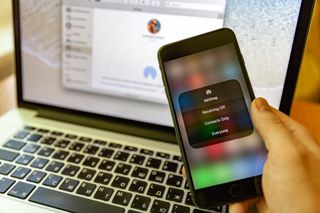
To brand certain you're non vulnerable to these attacks, you'll want to set your AirDrop to "Receiving Off" on an iPhone or iPad, and to "Permit me to be discovered past No Ane" on a Mac.
You might also want to turn off Wi-Fi and Bluetooth when y'all're not using them, although information technology's not clear whether doing so volition actually plow off AirDrop.
Alternatively, you could just let "Everyone" send yous AirDrop files, because and then there won't exist whatsoever exchange of e-mail addresses or phone numbers. You might end up seeing a lot of disturbing images sent past other iPhone users, though.
How AirDrop initiates connections
When your AirDrop-enabled device is ready to share a file, it broadcasts an encrypted form of your phone number and/or email address (whichever is tied to your Apple business relationship) to anything within Wi-Fi or Bluetooth range.
It does this so that other Apple devices with AirDrop set to the "Contacts Only" default can bank check to see whether you're in their users' contact lists in case you want to connect. (Devices with AirDrop set to "Everyone" doesn't perform this cheque, but withal receive the encrypted phone numbers or email addresses.)
The Apple devices don't broadcast actual phone numbers or email addresses. Rather, they send out "hashes" of those values, i.e. long strings of text you go when you run text through fixed mathematical algorithms.
For example, the phone number 1 (212) 555-1212, with spaces and parentheses removed, would come out of the SHA-256 hashing algorithm that AirDrop uses as "26321368f6c23510f79a21085024dd5a4f958e6c22dc057a358d1b5a1fc5c932."
Other Apple devices check those hashes against the hashes of electronic mail addresses and phone numbers they have in their own contact lists. If a match is made, then those devices reply to yours with their ain email and phone-number hashes.
If both devices have each other's contact information in their Contacts list, and then an AirDrop connection is made and files can be shared. (Over again, the "Everyone" setting skips this check and just shares files with anyone.)
Sounds practiced, simply there'due south a problem
The trouble is that while hashes are supposed to be irreversible — y'all shouldn't be able to punch back a hash to get the original phone number or email address — that's non exactly how information technology works in real life.
"Cryptographic hash functions cannot hibernate their inputs (called preimages) when the input space is small or predictable, such every bit for phone numbers or email addresses," states an academic paper authored by researchers Alexander Heinrich, Matthias Hollick, Thomas Schneider, Milan Stute and Christian Weinert.
Heinrich, Hollick and Stute previously worked on means to set on AirDrop's technical underpinnings.
In other words, because phone numbers follow predictable formats, it wouldn't take long for even a midrange computer to precompile a listing of known hashes for all the possible telephone numbers in a specific area lawmaking, or all 10 billion or so possible phone numbers in Due north America.
A hacker could put a precompiled list of telephone-number hashes on his laptop, then sit in a public identify — such as exterior the archway to a big corporation's headquarters at lunchtime — and passively collect the numbers of nearby iPhones as they attempt to set up AirDrop shares.
The hacker could also actively force other devices to requite upwardly their phone numbers. The assaulter could initiate AirDrop shares by sending out the hash of a phone number that many people were probable to have in their contact lists — say, a company'southward master switchboard number, or the number of its man-resource department.
Any passing iPhone with that number in its Contacts list would send back the hash of its own telephone number.
OK, so what if a stranger knows my mobile number?
Because mobile phone numbers are (mistakenly) used as identity verification for password challenges, bank-account logins and ii-gene authentication, you could cause a lot of damage if you got the phone numbers of high-profile individuals or anyone who owns a lot of Bitcoin.
Electronic mail addresses are a bit harder to precompile hashes for, as they don't arrange to whatsoever set length and tin comprise letters equally well as numbers. But a hacker could limit the precomputed hashes to addresses ending in "@gmail.com" or "@yahoo.com," or to addresses post-obit a company's specific addressing format.
"Alternatively, an attacker could generate an email lookup table from data breaches or employ an online lookup service for hashed email addresses," the paper states.
The hacker could then harvest email addresses in the same manner as the phone numbers. Those email addresses, the research paper notes, could be used "for fraudulent activities such as (spear) phishing attacks or making a turn a profit past selling personal data."
A solution presents itself
The Darmstadt researchers said they privately told Apple nearly the passive-assail scenario in May 2019, and the agile-assail 1 in October 2020. In July 2019, a second group independently found the passive-attack effect and went public with it.
"Apple has not yet commented if they plan to address these AirDrop bug," the research paper says. (Tom's Guide has reached out to Apple for annotate, and we will update this story when we receive a reply.)
The researchers have created an open up-source projection called "PrivateDrop" that "integrates seamlessly into the current AirDrop protocol stack."
They say PrivateDrop, which they told Apple about in October, will set AirDrop's data-leakage problems past substituting other values for the hashed phone numbers and email addresses.

Source: https://www.tomsguide.com/news/apple-airdrop-flaw-exposes-15-billion-devices-what-to-do
Posted by: stovermagicittake.blogspot.com
0 Response to "Apple AirDrop flaw exposes 1.5 billion devices — what to do"
Post a Comment